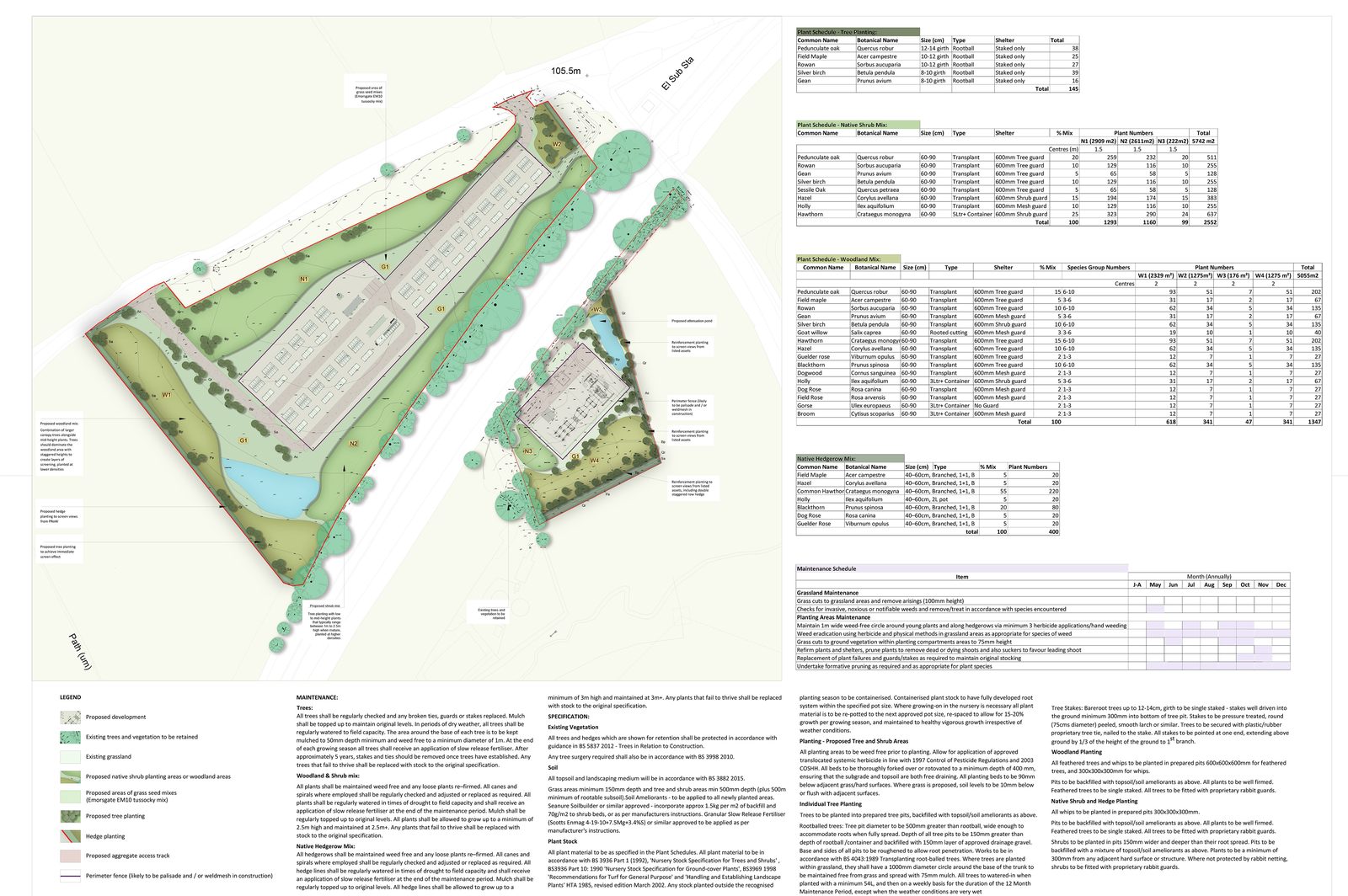
Mitigation is one of the most powerful tools available in a Landscape and Visual Impact Assessment (LVIA). While part of the LVIA process involves identifying potential adverse effects, it is equally important to demonstrate how these effects can be reduced, offset, or integrated into the existing landscape. Among all mitigation measures, planting design is perhaps the most widely used — and the most misunderstood.
Effective mitigation planting is not about concealment alone. It is about long-term integration, character enhancement, and visual harmony. When undertaken with care, planting can transform a potentially intrusive scheme into one that reads as a natural, contextually appropriate component of the wider landscape.
The role of mitigation in LVIA assessment
According to GLVIA3, mitigation is the process by which the adverse effects of a development are avoided, reduced, or offset. Within LVIA assessment, mitigation measures may be classified as:
- Primary mitigation: Embedded into the design from the outset (e.g. siting a building within a hollow or using reflective materials to minimise contrast).
- Secondary mitigation: Introduced in response to identified effects (e.g. hedgerow planting or woodland buffers).
- Tertiary or compensatory measures: Used where adverse effects cannot be avoided (e.g. habitat creation or offset planting off-site).
Planting typically falls into the secondary mitigation category, although best practice increasingly encourages design teams to incorporate landscape thinking early — so that planting is not merely reactive, but part of a coherent design response.
Objectives of mitigation planting
In LVIA work, mitigation planting can serve multiple purposes, often simultaneously. These may include:
- Visual screening: Reducing the visibility of structures from sensitive viewpoints.
- Landscape integration: Connecting new development to existing landscape patterns, forms, or vegetative cover.
- Perceptual softening: Breaking up massing or hard edges to reduce the perception of built form.
- Character reinforcement: Echoing species mixes, planting patterns, or structural forms typical of the local character area.
- Ecological enhancement: Contributing to biodiversity and habitat creation, potentially aligned with Biodiversity Net Gain objectives.
A well-prepared LVIA assessment will identify which effects are most capable of mitigation through planting — and which are not. It should then propose planting interventions that are appropriate, proportional, and place-specific.
Design principles for long-term integration
To be effective, mitigation planting must go beyond simplistic screens or peripheral buffers. The following principles are essential for successful design.
1. Character-led approach
Planting must reflect the local landscape character, not work against it. In open downland, for example, a dense belt of woodland may be more visually intrusive than the development it seeks to screen. Conversely, in a pastoral lowland fringe, new hedgerows and copses may offer both visual and ecological benefit. This requires reference to Landscape Character Assessments (LCAs), local landscape strategies, and where relevant, Historic Landscape Characterisation.
2. Structural depth and form
Linear planting alone is rarely sufficient. Mitigation planting should consider height, density, layering, and composition. Incorporating ground flora, understorey shrubs, and canopy species ensures both seasonal variation and textural complexity, which aids visual softening and ecological function.
3. Species selection
Native and locally appropriate species should be prioritised, drawing from regional planting lists, ecotype data, and historical precedent. Fast-growing exotics or overly ornamental species may undermine both visual integrity and long-term resilience.
4. Phasing and growth expectations
One of the most critical aspects of mitigation planting is time. LVIA conclusions must be clear about the year-1 effects and the residual effects at year-15 or year-20, when planting reaches maturity. Early-stage screening using advanced nursery stock or landform intervention may be appropriate, but only if realistic.
Where photomontages or verified views are presented, they must distinguish between short-term visibility and longer-term outcomes — and clearly indicate the assumptions made.
Need help on a specific project?
If you are working on a development that requires landscape and visual evidence, we can help. Tell us about your site and we will respond with a fixed fee and programme within one working day.