The brief
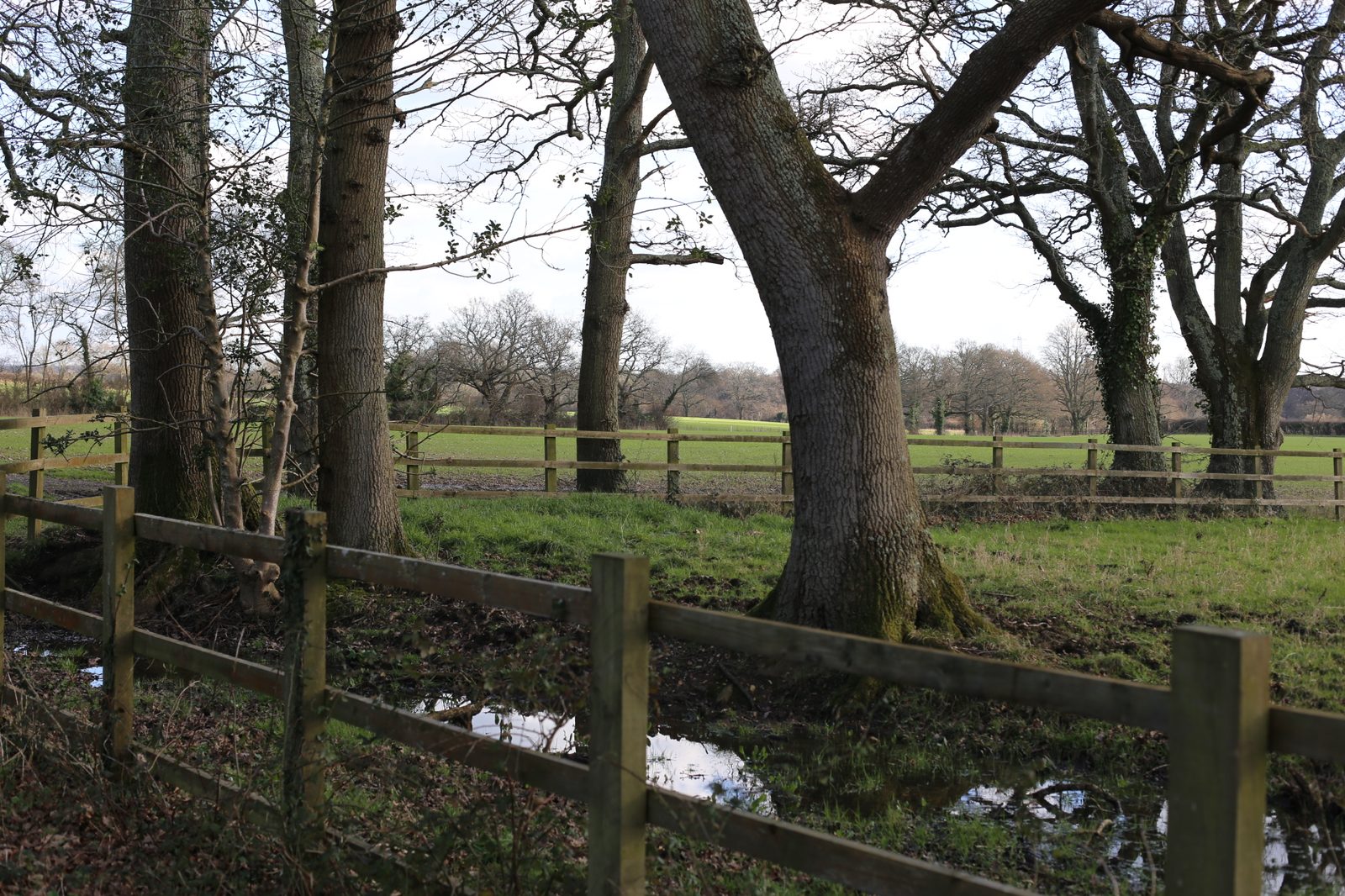
The Landscape Workshop was commissioned to prepare a Landscape and Visual Impact Assessment supporting a planning application for the erection of polytunnels and associated development on agricultural land at The Droveway, Romsey, in Test Valley, Hampshire. The site sits at just 15m AOD on a series of arable fields divided by hedgerows, with the River Blackwater running south of the site and Moorcourt Copse forming a wooded edge to the north-east.
The proposal sets out seven zones of polytunnels arranged across the existing field structure. The polytunnel frames are lightweight, between 3.5m and 4m high, and stand without permanent foundations — meaning the land can be reinstated to its previous use at any time. Critically, the plastic covering is only in place during the growing and harvesting season, after which it is rolled up and tied to the frame. The scheme also includes new internal access tracks and the main vehicular access from the north, with two recently consented reservoirs already forming part of the baseline.
The landscape and visual context
At the national scale the site lies within NCA 128 South Hampshire Lowlands, a low-lying, gently undulating Tertiary plain mixing pasture, hedgerows, watermeadow remnants and the influence of the M3 and M27 corridors. The wider area already accommodates pockets of intensive horticulture and market gardening — the polytunnel proposal sits, in land-use terms, within an established tradition rather than as a new departure. Locally, the site falls within Hampshire County LCA Test Valley 3b, an enclosed valley-side landscape transitioning from chalk to heavier clays, and within LCA 3B Melchet and Awbridge Wooded Farmland from the 2018 Test Valley Landscape Character Assessment, a landscape of contrasts where intimate hedge-bounded fields sit alongside more open arable.
The visual baseline focused on seven representative receptors along PRoW 057 11/1, PRoW 198 18/1 and 198 20/1 and bridleways 166 1/2, 166 19/2 and 166 501/1 — including two viewpoints from within the New Forest National Park itself. Tranquillity across the study area was already noticeably reduced by traffic noise from the M27 and A36 and by overhead pylons crossing the landscape, although receptor sensitivity along the PRoW network was assessed as high throughout.
Our approach
Polytunnels occupy a distinctive niche in landscape terms. Their geometry is regimented and their plastic skin is reflective when in season; but they are also low, lightweight, structurally reversible and fundamentally agricultural in function. The Test Valley LCA explicitly flags polytunnel development as a potential concern where it expands cumulatively or intrudes upon historic features and parkland — so the assessment had to address that concern head-on. We worked through each character area at NCA, LCA and site scales, then tested the scheme against each PRoW and bridleway viewpoint at Year 1 and Year 10, drawing a careful line between intrinsic landscape sensitivity and the lower sensitivity of this particular, infrastructure-influenced corner of it. Site survey and photography were carried out in February on a clear day with good visibility, capturing winter conditions when vegetative screening was at its weakest.
Mitigation and design response
The mitigation strategy leaned heavily on the existing field structure. All boundary hedgerows were to be retained, with offsets from Root Protection Zones and an additional 1m offset from Category A trees, providing both protection and a generous long-term maintenance buffer. Native reinforcement planting was specified to fill gaps and strengthen hedgerow continuity along the field edges, supporting both the LCA's call for enhanced hedgerow networks and Statement of Environmental Opportunity 3 of the South Hampshire Lowlands NCA. Internal tracks were aligned to follow existing field boundaries to minimise disturbance, and the planting framework was scheduled for the first available season following construction. Above all, the case for the scheme rested on its reversibility — the seasonal rhythm of plastic on, plastic off, and the fact that the land can be returned to open arable at any time, leaving only an enhanced hedgerow framework behind.
The outcome
At the NCA scale the assessment concluded a negligible magnitude of change and a neutral effect at both Year 1 and Year 10 — the polytunnels do not reconfigure landscape structure, do not introduce permanent built form, and sit within an NCA already familiar with horticultural land use. At LCA Test Valley 3b a low magnitude and slight adverse effect at Year 1 reduced to negligible and neutral by Year 10 as mitigation matured. The same pattern was reported for LCA 3B Melchet and Awbridge Wooded Farmland, where the assessment specifically engaged with the LCA's concerns about polytunnels and demonstrated that this scheme avoided each of the identified vulnerabilities — no parkland intrusion, no listed setting affected, no new access infrastructure cutting through rural lanes. Site-level effects were moderate adverse at Year 1, reflecting the honest reality of introducing a regular structural form into a previously open arable setting, reducing to slight adverse by Year 10. Visually, Viewpoints 1 and 2 on the closest PRoWs returned moderate adverse effects at Year 1 reducing to slight adverse by Year 10; Viewpoints 3, 4 and 5 along the surrounding bridleways recorded slight adverse effects diminishing to neutral; and the two viewpoints from within the New Forest National Park (VP6 and VP7) found the site entirely screened by intervening vegetation, returning neutral effects throughout. The assessment supported a defensible planning case for a reversible, seasonal horticultural use that strengthened rather than degraded the field-boundary fabric of the Test Valley landscape.
Working on a similar project?
If you are preparing a planning application that needs landscape and visual evidence — from a single dwelling to a major EIA scheme — we can help. Tell us about your site and we will respond with a fixed fee and programme within one working day.