The brief
We were commissioned to prepare a Landscape and Visual Appraisal supporting a planning application for the renovation and extension of an existing private dwelling in a small village in the Cotswolds National Landscape, near Bath. The proposal involved demolishing a single-storey ancillary building — garage, storage, outdoor restroom — and replacing it with a two-storey extension, alongside renovation works to the main house. The new design introduces a more symmetrical, balanced facade with a central portico, dormer windows on the upper floor, and large garden-facing glazed openings, executed in stone-coloured render with Bath stone quoin blocks, matched roof tiles and wooden sash windows.
This was a relatively modest scheme by scale, but it sat in a high-sensitivity setting that pulled in two issues a typical residential LVA does not always engage with: the Green Belt designation of the site, and — most importantly — the Cotswolds National Landscape’s explicit policy protection of dark skies. The assessment therefore had to do a full daytime LVA AND a structured night-time assessment, including night-time photography and a calibrated lighting strategy.
The landscape and visual context
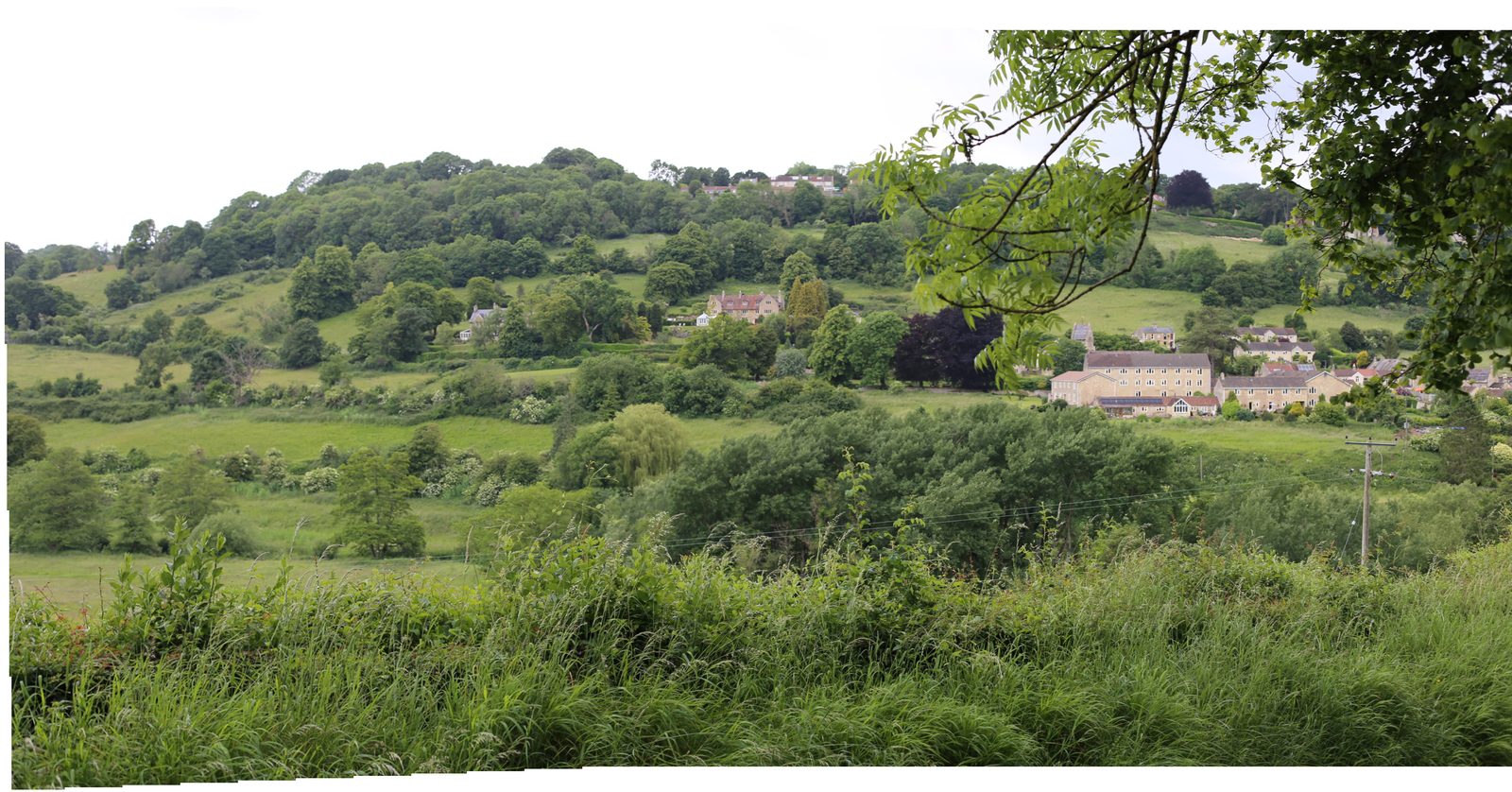
The site sits within NCA 107 Cotswolds and locally within LCA 4A Cam and Wellow Brook Valleys — a moderately broad, enclosed river valley landscape of steep wooded sides, mixed pasture and arable, dry-stone walls, ancient semi-natural woodland and scattered historic settlements. Both NCA and LCA were assessed as high value and high sensitivity, reflecting the National Landscape designation, the proximity of the Bath WHS, and the strong cultural and historic associations across the wider area. The CPRE Dark Skies map shows the site sitting in an area moderately affected by sky glow from Bath but with notably lower night-time light values immediately around the village itself — a still-dark pocket within a larger lit context.
Daytime field survey took place in late May on a clear day, with a second visit in late August to confirm baseline conditions in summer. The night-time photography was undertaken on a separate visit on a clear night in late June, working in accordance with Landscape Institute Technical Guidance Note 06/19 (Appendix 5: Night-Time Photography) and NatureScot guidance on night-time visualisation — photographs taken at the agreed receptors approximately 30 minutes after sunset, with a full-frame DSLR and an f/1.4 fast prime, mounted on a levelled tripod at 1.5m above ground level to approximate average adult eye level. Eleven representative viewpoints were assessed across the local PRoW, bridleway, lane and National Cycle Route network, with night-time photographs added at the four most sensitive positions where the site or its immediate setting was visible.
Our approach
The Cotswolds National Landscape Management Plan 2023–2025 lists ‘extensive dark sky areas’ as one of the National Landscape’s special qualities and Policy CE5 (Dark Skies) sets out an explicit expectation that development will not erode them. This is one of the few residential cases where the night-time conversation matters as much as the daytime one. We worked through the eleven viewpoints in daytime first to establish daytime visibility and effects, then re-walked the most sensitive receptors at dusk and through into full darkness to capture how the existing baseline reads at night — sky glow, the position and intensity of nearby lit windows and street lighting, the influence of nearby canal boats and the Senior School, and the role of dense valley vegetation in containing light spill.
Mitigation and design response
Daytime mitigation followed familiar principles: full retention of the existing hedgerow and tree framework around the property, with new native tree and hedge planting along the southern and eastern boundaries to reinforce the strategic landscape structure. The materials palette — stone-coloured render, Bath stone quoin blocks, matching tile and timber sash windows — was chosen to anchor the new work in the local vernacular, and the new footprint replaces a less coherent ancillary structure that had detracted from the property’s overall coherence.
The night-time mitigation strategy — prepared by a specialist lighting designer in parallel with our visual assessment — was where the project did its real work. All existing internal and external light fittings were specified for replacement with downlights with full horizontal cut-off, eliminating upward light spill at source. Internal areas would use recessed LED downlights at 2700–3000K colour temperature — strictly warm white, with daylight or blue-rich light fittings explicitly excluded. Lighting controls were specified to dim or switch off lights based on time of day and occupancy, so that the building would not bleed light into the valley after the household had retired. Together these measures aligned the proposal directly with Policy CE5 and protected the dark-sky character of the surrounding landscape.
The outcome
At the NCA 107 Cotswolds scale, effects were assessed as neutral at both Year 1 and Year 10 — the development is too small and too localised to register at the national character area level. At LCA 4A Cam and Wellow Brook Valleys, the same neutral finding applied. At site level the effect was reported as slight adverse at Year 1, reducing to neutral by Year 10 as the reinforced planting and overall design coherence took effect.
Visually, eight of the eleven daytime viewpoints returned neutral effects throughout. Two close-range viewpoints — from the riverside footpath and from the lane outside the property — reported moderate adverse effects at Year 1 reducing to slight adverse by Year 10, and one viewpoint from the church grounds returned a slight adverse effect at Year 1 reducing to neutral by Year 10. The remaining longer-range viewpoints (including from a Scheduled Monument and from positions within nearby Conservation Areas) returned neutral effects throughout.
The night-time results were the headline finding. At the four viewpoints assessed for night effects, the proposal was either neutral or only slight adverse — and in every case the residual sky glow was bounded by the existing night-time context of the village, the school and the valley vegetation, rather than meaningfully extending it. The lighting strategy’s combination of warm white temperature, full horizontal cut-off, and time-of-day controls meant that the additional footprint did not translate into additional light bleeding into the dark sky. The assessment concluded that the proposals would not cause a detrimental impact on the dark skies of the Cotswolds National Landscape and were therefore compliant with Policy CE5: Dark Skies of the Cotswolds National Landscape Management Plan 2023–2025 — a defensible finding that gave the design team and the planning case clear, evidence-led grounds on the most distinctive landscape constraint at this site.
Working on a similar project?
If you are preparing a planning application that needs landscape and visual evidence — from a single dwelling to a major EIA scheme — we can help. Tell us about your site and we will respond with a fixed fee and programme within one working day.