The brief
The Landscape Workshop was instructed to prepare a Townscape and Visual Impact Assessment in support of a planning application for the remodelling and adaptive reuse of 125–139 Queen Street, Cardiff — a substantial three-storey, locally-listed Art Deco building occupying the corner of Queen Street and Dumfries Place at the eastern entrance to the Queen Street shopping district. The host building has 3,883 sqm GIA across three floors, with an active retail parade at street level and largely under-used upper floors that have fallen into a degree of disrepair.
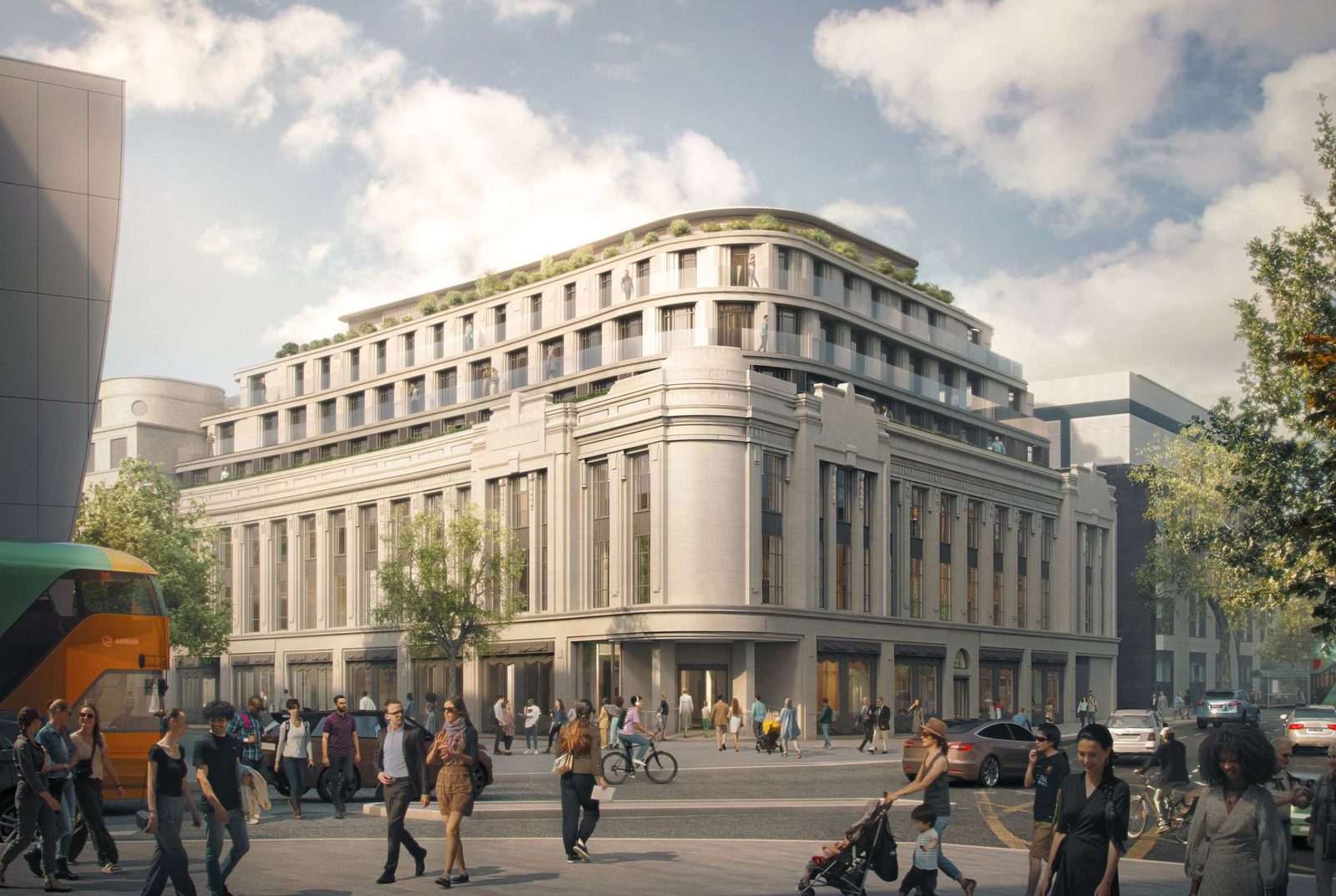
The scheme proposes a substantial transformation while keeping the building’s most valued features intact: a new rooftop extension creating a hotel with rooftop restaurant and bar, the reconfiguration of the existing shop units, a new rendered façade with new fenestration, external lighting and signage, a new passenger lift, a new dedicated hotel entrance to Queen Street, ancillary refuse storage and bicycle provision, and local public realm improvements. Verified views were prepared by Paul Treacy Architects and sat alongside our TVIA in the planning evidence base.
The townscape and visual context
The site sits within NLCA 35 Cardiff, Barry and Newport, and — critically — within the Queen Street Conservation Area, on the boundary of Cardiff Council’s designated ‘Area of Very High Sensitivity’ to buildings significantly taller than the prevailing townscape. The Conservation Area Appraisal explicitly identifies the building as a Landmark Building: socially and historically significant, unique within its setting and contributing positively to the area’s character. Its front corner curvature, where the Sainsbury’s entrance now sits, is locally listed in its own right.
The Art Deco features are the asset to protect: stepped pilasters with subtle decorative elements, classical-inspired triglyphs and keystones, ornamental fasces and bead-and-reel carvings, an egg-and-dart cornice above the second floor, a recessed parapet, and the gentle curved building line that follows the street alignment and forms one of the key views into Queen Street itself. The wider townscape context was assessed across five Townscape Character Areas — the Windsor Place Conservation Area to the north (TCA1), the modern Windsor House and Summit House student accommodation block (TCA2), the Queen Street Conservation Area itself (TCA3), the Postmodern Capitol Shopping Centre (TCA4), and the high-density mixed-use cluster at The Aspect, the multi-storey car park and Cardiff University buildings (TCA5).
Seven representative viewpoints were assessed: along Queen Street looking east (VP1) and looking back west (VP6), from Dumfries Place at the signal-controlled crossing (VP2), at street level on the Conservation Area edge (VP5) and looking south along Dumfries Place (VP4), and from Newport Road in both distant background (VP3) and corner-prominent (VP7) positions.
Our approach
TVIA work in a city centre is a different conversation to rural LVIA. The defining issues here were the Art Deco fabric and its contribution to the Conservation Area, the height profile of an extension stepping above an established three-storey datum, the relationship to the curated key views into Queen Street, and the inevitable comparison with adjacent taller modern interventions — Windsor House, Summit House, The Aspect, Brunel House and Landmark Place. Our approach was to read each TCA on its own terms, distinguish honestly between high-sensitivity historic fabric and lower-sensitivity modern surroundings, and test whether a sensitively designed rooftop addition could enhance the building’s landmark role rather than diminish it.
Mitigation and design response
This was the rare project where the right answer was neither concealment nor compromise. The mitigation built into the design was retention and restoration: the Art Deco lower façade kept and restored, the curved alignment along Queen Street preserved, and the relationship between ground-floor activity and the pedestrianised public realm strengthened by a revitalised retail frontage. The new rooftop extension was set back and stepped to soften the transition from the historic base to the modern addition, with a contemporary material palette and fenestration calibrated to read as clearly distinct from — but cohesive with — the Art Deco below. Rooftop greenery was introduced as a softening element to the skyline, and the change of use to a hotel addressed the under-utilisation of the upper floors that had been steadily eroding the building’s contribution to its setting.
The outcome
This case is unusual in our portfolio for the simple reason that almost every reported effect was beneficial. At the NLCA scale the magnitude of change was low and the effect slight beneficial, with the proposal modernising the building’s contribution to Cardiff’s evolving city-centre skyline without compromising its Art Deco identity. At TCA1 (Windsor Place Conservation Area), the development was effectively screened by the existing Windsor House block and the effect was neutral. At TCA2 (Windsor House and Summit House), the stepped height and design language of the extension read as a natural progression — slight beneficial. At TCA3 (Queen Street Conservation Area), the most sensitive receptor, the effect was assessed as moderate beneficial, with the preserved Art Deco base, the stepped rooftop transition and the active ground-floor frontage strengthening rather than diluting the Conservation Area’s landmark composition. The same moderate beneficial finding applied to TCA4 (the Capitol Shopping Centre), where the architectural articulation lifted the local skyline. At TCA5 (The Aspect / multi-storey / university buildings), the effect was slight beneficial. At site level the effect was moderate beneficial. Visually, every one of the seven assessed viewpoints reported positive change — ranging from slight beneficial in the more peripheral Newport Road background view (VP3) to moderate beneficial across the six closer-range receptors. The TVIA gave the design team and the planning case a clear, evidence-led narrative: a sensitive, contextual rooftop intervention that revives a tired but locally-cherished Art Deco landmark and reinforces its role as one of the defining buildings at the entrance to Queen Street.
Working on a similar project?
If you are preparing a planning application that needs landscape and visual evidence — from a single dwelling to a major EIA scheme — we can help. Tell us about your site and we will respond with a fixed fee and programme within one working day.