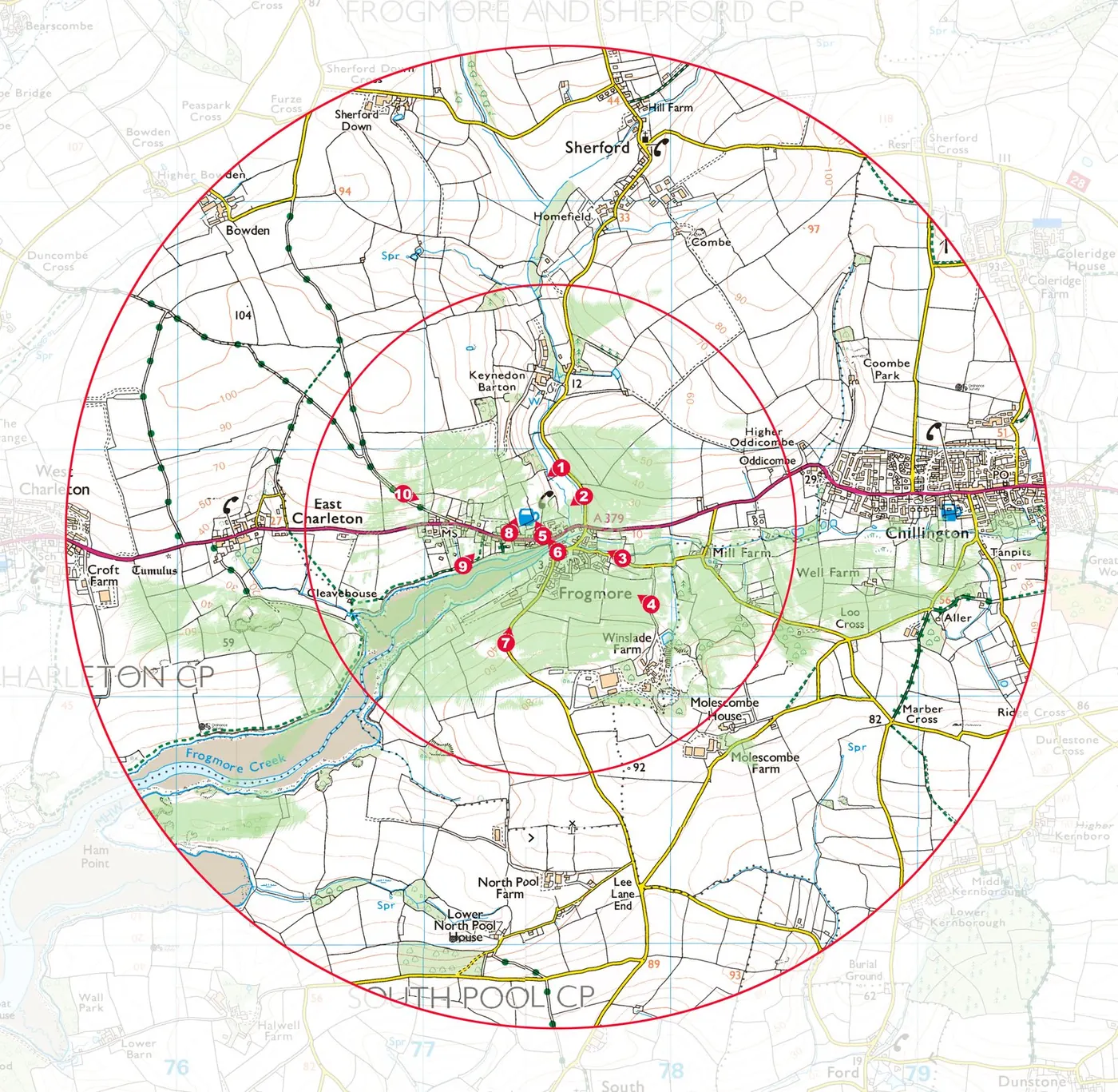
Large developments in the countryside, such as solar farms, battery storage sites, wind turbines and overhead lines, are often proposed close to individual homes and farmsteads. A standard Landscape and Visual Impact Assessment (LVIA) considers residents as one group of visual receptors among many. A Residential Visual Amenity Assessment (RVAA) goes further, looking property by property at the effect on the views and outlook from people's homes.
What is an RVAA?
An RVAA is a focused assessment of the likely change to the visual amenity of residential properties. The Landscape Institute's Technical Guidance Note 2/19, Residential Visual Amenity Assessment, published in 2019, sets out good practice. It builds on the Guidelines for Landscape and Visual Impact Assessment, third edition (GLVIA3), and is now the accepted reference for RVAAs across the UK.
Visual amenity, in this context, is the overall pleasantness of the views residents enjoy from their homes and gardens, and the visual setting the property provides as a place to live. It is not the same as a right to a view: the planning system does not protect a private view as such. The RVAA asks a narrower question, whether the effect on a property would be so great that it becomes a matter of wider public interest.
When is an RVAA needed?
An RVAA is most commonly requested for:
- wind turbines, where it originated through public inquiry decisions;
- solar farms and battery energy storage systems close to dwellings;
- overhead lines, substations and other grid infrastructure;
- large agricultural, industrial or commercial buildings next to isolated homes.
It may be requested by the local planning authority at scoping or pre-application stage, raised by residents during consultation, or prepared voluntarily by the applicant where homes are close to the site and the issue is likely to arise at appeal.
The four steps in TGN 2/19
TGN 2/19 describes a four-step process:
- Define the study area and scope. The study area is set according to the scale and nature of the development. For large wind turbines the guidance indicates a preliminary radius of around 1.5 to 2 km may be appropriate; for lower structures such as solar panels it is usually much smaller. Properties within the area are identified, often using a Zone of Theoretical Visibility.
- Evaluate the baseline visual amenity. For each property, the assessor records the existing views from the dwelling and its garden and approaches, the orientation of main rooms and windows, and the screening provided by buildings, landform and vegetation.
- Assess the likely change. Following GLVIA3 principles, the magnitude and nature of the change to each property's views and visual amenity are assessed, taking account of distance, extent, scale, movement and any mitigation.
- Judge the effect against the Residential Visual Amenity Threshold. Where the change is substantial, the assessor considers whether it would reach the threshold described below.
The Residential Visual Amenity Threshold
The threshold reflects a principle established through planning appeal and inquiry decisions, sometimes called the "Lavender test" after the Inspector who first articulated it. It recognises that a significant visual effect on a home, in the EIA sense, is not on its own a reason to refuse planning permission. The question is whether the effect would be so overwhelming or overbearing that the property would become an unattractive place in which to live, such that it is in the public interest to protect it.
The threshold is deliberately set higher than EIA significance. Many properties will experience significant effects without reaching it. That is why the RVAA is reported separately from the LVIA: the LVIA identifies significant effects, while the RVAA informs the decision-maker's judgement on residential amenity in the planning balance.
What makes a robust RVAA
- Proper property-level evidence. Assessments based on public viewpoints and aerial imagery alone are easily challenged. Where access is possible, observations from the property itself carry more weight; where it is not, the limitations should be stated clearly.
- Attention to the whole residential curtilage, including gardens and the approach to the house, not only the views from windows.
- Clear visual material, such as wirelines or photomontages from or near the property, prepared in line with Landscape Institute Technical Guidance Note 06/19.
- Transparent reasoning that separates the description of the change from the judgement on the threshold.
- Mitigation, such as planting, set-backs or layout changes, where it would reduce effects on the most affected properties.
RVAA and the LVIA
An RVAA is usually prepared alongside an LVIA, sharing its baseline, viewpoints and visualisations. Preparing them together keeps the methodology consistent and avoids duplication. For smaller schemes the RVAA can be a technical appendix to the LVIA; for larger energy and infrastructure projects it is often a standalone report.
Common questions
Do residents have to give access? No. Access is helpful and is always requested where appropriate, but an RVAA can be prepared from publicly accessible locations as long as the limits of the evidence are explained.
Does reaching the threshold mean refusal? Not automatically. It is a material consideration that weighs heavily in the planning balance, and it usually leads to changes to the layout or the omission of elements closest to the affected property.
Who should prepare it? An RVAA should be prepared by a Chartered Landscape Architect experienced in visual assessment, ideally the same team preparing the LVIA, so that the baseline, viewpoints and judgements are consistent.
In summary
If your scheme is close to homes, an RVAA gives the decision-maker a clear, property-by-property answer to a question that will otherwise be argued without evidence. Prepared early, it can also shape the layout and planting so that effects on the nearest homes are reduced before the application is submitted.
Need a Residential Visual Amenity Assessment?
Whether the council has asked for an RVAA or you want to understand the effect on nearby homes before you submit, we can help. Tell us about your scheme and we will respond with a fixed fee within one working day.